Legal
What Legal Documents Do I Need as a Freelancer? Four Cover Almost Every Job
Starting out, the paperwork question feels bigger than it is. You don't need a law degree or a filing cabinet. For most freelance work, four documents cover the engagement end to end, and two more show up only when a particular client asks for them.
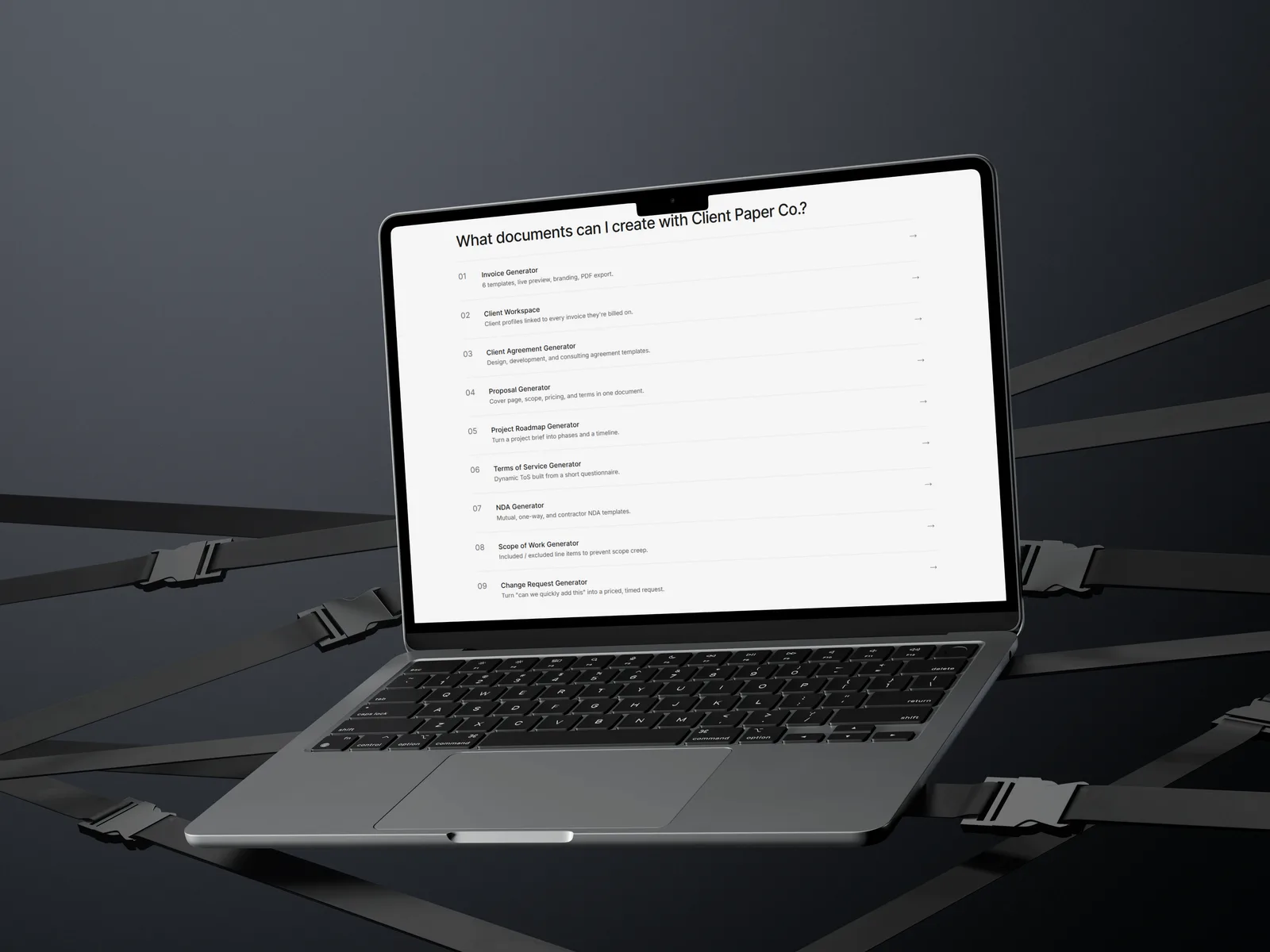
The four documents that cover almost every freelance engagement
A freelance contract sets the terms of the relationship: payment, revisions, IP, termination. A scope of work defines what you're actually delivering, line by line, and stays separate from the contract so you can update it per project without renegotiating everything. An invoice is the payment demand itself, and it's the document a client's accounts team files. A change request captures anything added after the scope was agreed, with its own price and timeline. Those four handle the full arc of a normal project (agree, define, deliver, bill), and skipping any one of them is where the common disputes start. Freelancers who have all four but no change request process are the ones who end up doing three extra rounds of work for free.
| Document | What it protects | When you need it |
|---|---|---|
| Freelance contract | Payment terms, IP ownership, termination, liability | Before any work starts, every client |
| Scope of work | What's included and excluded, so extra work is visibly extra | Per project, attached to the contract |
| Invoice | Your right to be paid a stated amount by a stated date | Every billing cycle or milestone |
| Change request | Additional work getting priced instead of absorbed | Any time scope grows mid-project |
The two that depend on the client, not on you
An NDA and a set of terms of service are conditional. An NDA comes up when a client is sharing something genuinely confidential (unreleased product work, customer data, financials) and is usually the client's document rather than yours; you sign theirs more often than you issue your own. Terms of service matter if you sell anything productized: a fixed-price package, a template, a subscription retainer where a full negotiated contract per customer isn't practical. If your work is bespoke, per-client, and contracted individually, you can go a long time without needing your own terms of service at all. Don't build documents in advance for a situation you're not in yet.
What's legally required versus what just protects you
In most places, no law requires a written contract for freelance work. An oral agreement is technically binding, it's just close to unenforceable when the two sides remember it differently. That gap is narrowing, though. California's Freelance Worker Protection Act (SB 988) took effect January 1, 2025 and requires a written contract for freelance work over $250, plus payment within 30 days when no due date is stated. New York's Freelance Isn't Free Act requires a written contract at $800 or more, a New York City rule since 15 May 2017 that went statewide on 28 August 2024. Illinois' Freelance Worker Protection Act, effective 1 July 2024, sets the lowest practical trigger of the three, at $500 counted in aggregate across a 120-day period. All of them put the obligation on the hiring client, not on you, and none of them helps if nobody wrote anything down. Meanwhile the most-cited figure on contract use, 28% of freelancers using a written contract for a given gig, comes from a Freelancers Union survey of roughly 5,000 freelancers, and it is a decade old now, which means it predates every one of these statutes. Treat it as evidence that the habit was weak before the law arrived, not as a current measurement.
Business registration and tax: the paperwork that isn't a document
Separate from client-facing documents, there's a second category: your own business setup. In most countries you can invoice under your own legal name as a sole proprietor without registering anything, and registration becomes worth it for liability separation or tax treatment rather than legality. Tax identifiers vary the most (a GST number in India, VAT registration in the EU and UK, a W-9 and 1099 reporting relationship in the US), and thresholds change often enough that a local accountant's answer beats a general one. None of this blocks your first invoice. Get the four client documents in place, invoice under your own name, and sort registration once your income is predictable enough that the decision has actual consequences. This is general information, not legal or tax advice.
Frequently asked questions
- Can I start freelancing without registering a business?
- In most jurisdictions, yes: you can work and invoice as a sole proprietor under your own legal name. Registration usually becomes relevant for liability protection, tax treatment, or crossing a revenue threshold, not for permission to take on your first client. Check local rules once your income is steady.
- Do I need a lawyer to draft my freelance contract?
- Not for standard project work. A solid template covers the common case: one client, a defined project, normal payment terms. Bring in a lawyer for equity-instead-of-cash deals, significant IP transfers, foreign governing law, or any engagement large enough that a dispute would genuinely hurt your business.
- What's the difference between a contract and a scope of work?
- The contract governs the relationship (payment, IP, liability, termination) and rarely changes. The scope of work describes the deliverables for one specific project and changes often. Keeping them separate means you can start a new project with the same client by issuing a new scope rather than a whole new contract.
Sources
- Freelancers Union - Why do only 28% of freelancers use a contract? (survey of ~5,000 freelancers)
- California Legislative Information - SB-988, Freelance Worker Protection Act
- Jackson Lewis - Illinois Enacts Freelance Worker Protection Act
- Foster Garvey - New Protections for Freelancers Statewide Under the New York Freelance Isn't Free Act
- IRS - About Form 1099-NEC, Nonemployee Compensation