Client Management
Freelancers Lose 204 Hours a Year to Paperwork. The Survey Says Where - and AI Isn't Fixing It
Admin is the part of freelancing nobody prices. It shows up as evenings, not as a line item, which is exactly why it goes unexamined for years. A 2026 survey put a number on it - and the more interesting finding is not the size of the number but which specific tasks it is made of, and how little the obvious fix has helped.
The number, and how much weight it can carry
The headline figure comes from Smallpdf's Freelancer Freedom Index, a 2026 survey of 397 freelancers: an average of 204 hours a year lost to admin and paperwork, and close to $6,800 in annual income foregone as a result. Read it as an order of magnitude, not a measurement. It is a vendor survey with a self-selected sample of under 400, which means it over-represents people who already feel strongly about paperwork, and it does not publish a geographic breakdown. What it is good for is the shape of the problem - 204 hours is roughly five working weeks, and even if the true figure is half that, it is still more time than most freelancers spend on business development in a year. Independent estimates land in a compatible range: 8 to 12 hours a month on creating and chasing invoices alone, or admin consuming up to a fifth of the working week.
Where the hours actually go: formatting, not thinking
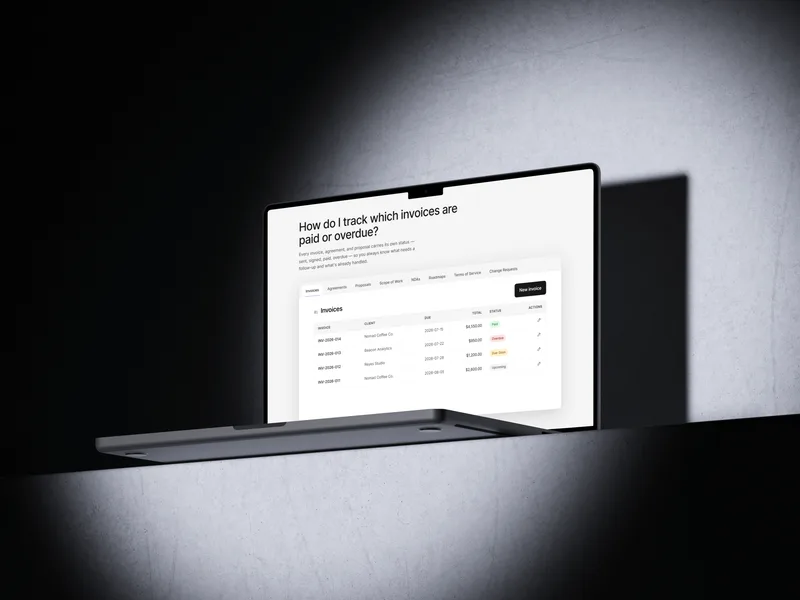
The single most time-consuming weekly admin task in the survey was document formatting, named by 38% of respondents. That is a striking result, because formatting is the part of paperwork with the least judgement in it - nobody is deliberating over margins, they are re-doing the same layout for the fourth time this month. The second cluster is chasing: 54% wait more than a week for payment after invoicing and 24% wait two weeks or longer, and each of those waits generates follow-up work that would not exist if the invoice had landed correctly the first time. A third cluster is visibility. 35% said they could not tell whether a client had opened a contract or proposal they sent, and 35% reported pushback, delay or outright ghosting at the contract and proposal stage - two findings that describe the same underlying problem, which is sending a document into a void and having no signal to act on.
| Finding | Share of respondents |
|---|---|
| Document formatting is the most time-consuming weekly admin task | 38% |
| Wait more than a week for payment after invoicing | 54% |
| Wait two weeks or longer for payment | 24% |
| Cannot tell whether a sent contract or proposal was opened | 35% |
| Hit pushback, delay or ghosting at contract or proposal stage | 35% |
| Lost clients or undercharged because of paperwork friction | 31% |
| Had 5% or more of invoiced money written off or unpaid | 15% |
| Have considered quitting freelancing over the admin burden | 14% |
Why AI has barely moved the number
The survey's most useful finding is a negative one. 70% of respondents already use AI for administrative tasks and 65% use it for billable client work, yet 48% said it had done little to reduce their admin workload - rising to 58% among solopreneurs. That is a large adoption rate producing a small effect, and the reason is visible in the task breakdown above. Generation was never the bottleneck. Writing the words in a proposal is the part a language model genuinely accelerates; formatting the same document to look consistent, remembering which of eleven clients it belongs to, knowing whether it was opened, and noticing that client seven has not paid since June are all state problems, not writing problems. A tool that produces a better document faster and then hands it back to you as a loose file has improved the cheap half of the work.
Which parts are actually worth systematising
Rank the admin tasks by how much judgement they require and automate from the bottom. Formatting is judgement-free and repeated - it should be a template applied once, with your logo and brand colour set at the account level rather than re-applied per document. Filing is judgement-free - a document should attach itself to the client it was created for at the moment of creation, because retrospective filing is what never happens. Status is judgement-free - paid, sent, overdue, signed is a small state machine and it should be a field, not a memory. What is left after that is the genuinely human part: deciding what to charge, deciding whether a change request is worth accepting, and deciding when a late payment stops being a delay and becomes a problem. Those are the decisions worth having 204 hours back for.
The after-hours finding, and why it matters more than the hours
79% of millennial freelancers and 57% of Gen X respondents handle admin outside business hours. That reframes the whole number. 204 hours a year is not primarily competing with billable work - it is competing with evenings and weekends, which is why it rarely shows up as an obvious business cost and why 14% of respondents have considered leaving freelancing over it. A cost that lands on unpaid time is one you can absorb indefinitely without ever being forced to fix it. That, more than the raw hours, is the argument for treating client paperwork as a system rather than a chore: nothing else in the business is going to force the issue.
Frequently asked questions
- How much time do freelancers spend on admin?
- A 2026 Smallpdf survey of 397 freelancers put it at an average of 204 hours a year - roughly five working weeks - with about $6,800 in associated lost income. Other estimates put invoice creation and chasing alone at 8 to 12 hours a month, and admin generally at up to a fifth of the working week. Treat these as an order of magnitude: the survey is vendor-run with a self-selected sample under 400.
- What is the single biggest freelance admin time sink?
- Document formatting, named by 38% of respondents as the most time-consuming weekly admin task. It is also the one with the least judgement in it, which makes it the first thing worth eliminating with templates and account-level branding rather than per-document work.
- Has AI reduced freelance admin work?
- Much less than adoption would suggest. 70% of respondents use AI for admin tasks, but 48% said it had done little to reduce their workload, rising to 58% among solopreneurs. The likely reason is that AI accelerates generating text, while most admin cost sits in state - formatting consistency, filing, knowing who has paid - which text generation does not touch.
- Is freelance admin time actually costing me money?
- Partly, but the more common pattern is that it costs unpaid time rather than billable hours: 79% of millennial and 57% of Gen X respondents do admin outside business hours. That is why it persists - a cost absorbed by evenings never forces a decision. 31% did report losing clients or undercharging because of paperwork friction, and 14% have considered quitting freelancing over it.